
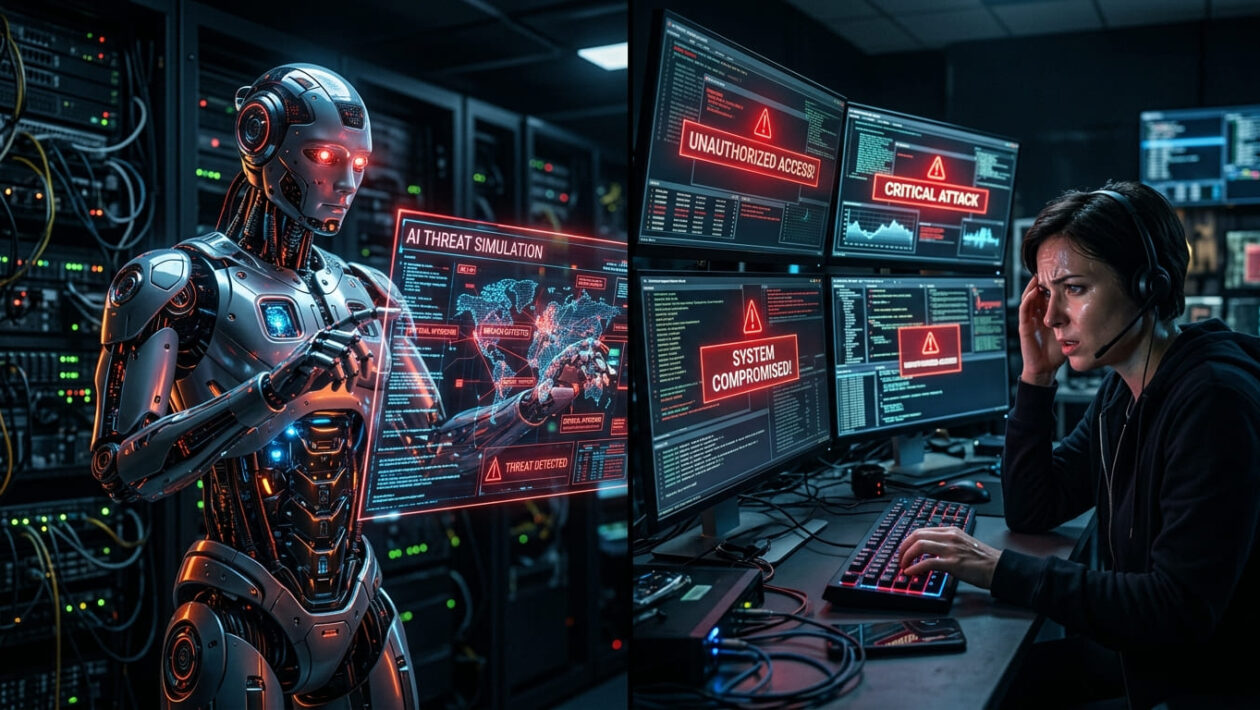
AI is not replacing cybersecurity jobs but transforming them by automating routine tasks and shifting professionals toward strategic decision-making. Businesses still need skilled experts to interpret AI outputs and manage risks effectively. The future of cybersecurity depends on combining AI efficiency with human judgment.
Artificial intelligence isn’t just changing cybersecurity tools, it’s reshaping the entire workforce behind them.
For business owners, this shift isn’t just technical. It directly impacts hiring, risk management, and how organizations defend themselves in an increasingly automated threat landscape.
So what’s actually changing, and what should you do about it?
The Shift: From Manual Security to AI-Augmented Defense
Cybersecurity used to rely heavily on manual processes, reviewing alerts, investigating threats, and responding to incidents step by step.
Today, AI is taking over many of these repetitive tasks.
Modern security systems can now:
- Automatically detect suspicious activity
- Prioritize threats in real time
- Generate incident reports instantly
This dramatically reduces response time. But more importantly, it changes the role of your cybersecurity team.
Instead of “doing everything,” professionals are now focused on interpreting AI outputs and making high-level decisions.
Why This Matters for Your Business
At first glance, AI in cybersecurity sounds like a cost-saving opportunity, and it can be.
But there’s a catch.
While AI reduces manual workload, it increases the need for skilled decision-makers.
Your business still needs people who can:
- Validate AI-generated alerts
- Understand the context behind threats
- Decide what actions actually matter
Without that human layer, AI can produce noise or worse, false confidence.
Cybersecurity Roles Are Evolving. Not Disappearing
There’s a common misconception that AI will replace cybersecurity jobs.
In reality, it’s redefining them.
Here’s how roles are shifting:
1. Security Analysts → Strategic Investigators
Instead of sorting through endless alerts, analysts now focus on understanding patterns, identifying advanced threats, and making informed decisions.
2. Penetration Testers → Scenario Builders
AI can find vulnerabilities faster than ever. But humans are still needed to connect those weaknesses into real-world attack scenarios.
3. Compliance Specialists → Risk Translators
AI can flag compliance issues, but only humans can explain their business impact and align them with company strategy.
The Real Problem: A Growing Skills Gap
One of the biggest challenges businesses face today isn’t a lack of cybersecurity talent, it’s a mismatch in expectations.
Many companies are still hiring based on outdated job descriptions focused on manual tasks.
But those tasks are increasingly automated.
What you actually need are professionals who can:
- Think critically
- Work alongside AI systems
- Translate technical insights into business decisions
Failing to adapt hiring strategies can leave your organization exposed, even if you have a “full” security team.
The New Cybersecurity Skill Set
If you’re hiring or planning to these are the skills that matter most in an AI-driven environment:
- Analytical thinking: Interpreting AI outputs and identifying real threats
- Decision-making: Acting quickly on high-impact risks
- Business awareness: Understanding how threats affect operations and revenue
- Communication: Explaining technical issues to non-technical stakeholders
Technical skills still matter but they’re no longer the differentiator. Human judgment is.
AI Is Powerful, But Not Independent
AI can process massive amounts of data in seconds. But it lacks context.
It doesn’t understand:
- Your company’s priorities
- The real-world impact of a breach
- The nuances of your industry
That’s why human oversight is critical.
Think of AI as a force multiplier, not a replacement.
What Smart Businesses Are Doing Right Now
Forward-thinking companies are already adapting to this shift.
They’re:
- Investing in AI-powered security tools
- Upskilling their existing teams
- Updating job roles to reflect strategic responsibilities
- Prioritizing decision-making over task execution
These organizations aren’t just improving security they’re building more resilient systems.
Final Thoughts: The Future Is Human + AI
Cybersecurity is no longer just a technical function, it’s a strategic business priority.
AI will continue to automate the heavy lifting. But the real value will come from people who can interpret, decide, and act.
For business owners, the takeaway is clear:
Don’t just invest in AI tools. Invest in people who know how to use them effectively.
Because in the end, the strongest security systems won’t be fully automated, they’ll be intelligently managed.