
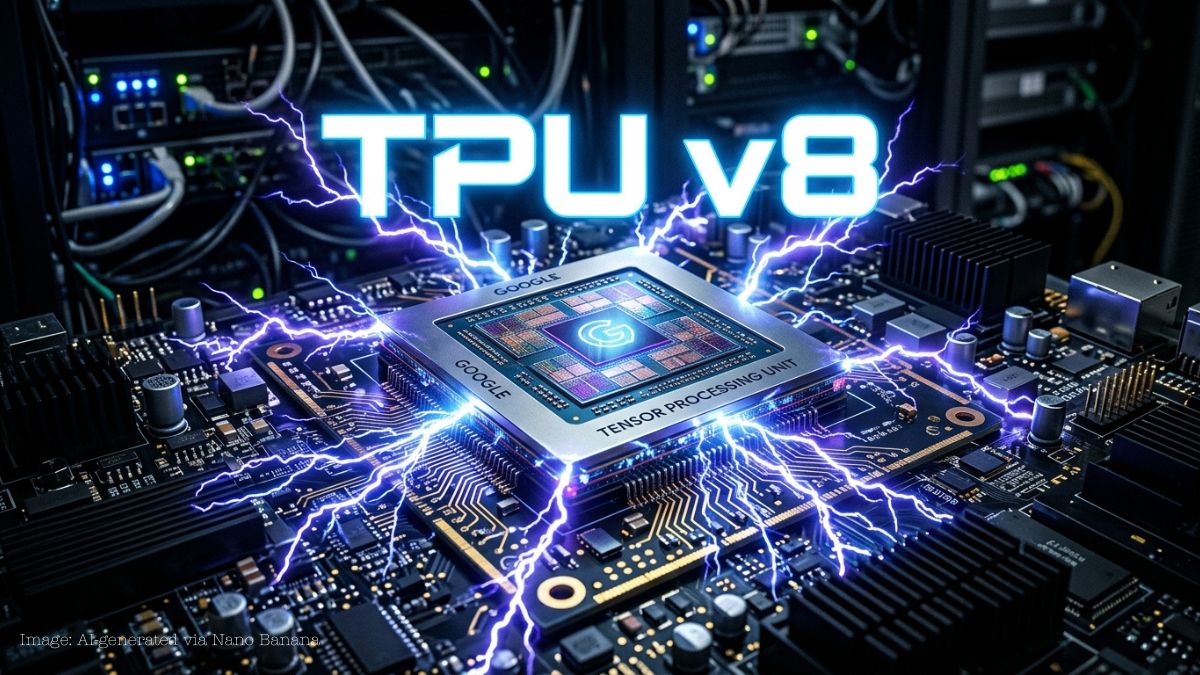
Google introduced its eighth-generation TPU v8 chips at Cloud Next 2026, designed to power advanced AI agents. The new dual-chip system improves training and inference performance, supporting more complex, autonomous AI workflows.
AI infrastructure is evolving to support more advanced systems capable of reasoning, planning, and executing tasks autonomously. This shift toward “agentic AI” requires significantly more computing power and efficiency than traditional models.
Cloud providers are now building specialized hardware to meet these demands. Instead of general-purpose chips, companies are designing AI accelerators tailored for specific workloads like training and inference.
What are Google’s TPU v8 chips?
Google’s TPU v8 chips are its latest custom AI accelerators designed to handle the demands of next-generation AI systems.
The eighth-generation lineup introduces two specialized chips: one optimized for training large AI models and another for running them efficiently in real-world applications. This dual approach improves both performance and scalability.
As reported by Google (2026), the TPU v8 includes TPU 8t for training and TPU 8i for inference, both designed to power large-scale AI workloads and agent-based systems.
Why is Google splitting chips into training and inference?
Google split the chips to optimize performance for different stages of AI development.
Training large models requires massive computational power, while inference focuses on speed and efficiency when delivering results to users. By separating these functions, Google improves cost efficiency and performance across both use cases.
Research from Ars Technica (2026) highlights that this dual-chip design reflects a broader industry shift toward specialized AI infrastructure.
How do TPU v8 chips support the “agentic AI” era?
TPU v8 chips are designed to support AI agents that can perform tasks autonomously rather than just respond to prompts.
These systems require continuous reasoning, fast response times, and the ability to handle complex workflows. The new chips provide the computing power needed to support these capabilities at scale.
Google stated the new TPUs are built to power “agent development” and large-scale inference workloads, enabling more advanced AI applications.
What impact will this have on AI infrastructure competition?
The launch of TPU v8 strengthens Google’s position in the AI infrastructure market.
By developing its own custom chips, Google reduces reliance on external suppliers and competes more directly with companies like Nvidia. This move also supports its broader strategy of offering a full-stack AI platform through its cloud services.
What happens next?
Google is expected to roll out TPU v8 chips later in 2026, with broader availability through its cloud platform. As demand for agentic AI grows, further updates will likely focus on scaling infrastructure, improving efficiency, and supporting more advanced autonomous systems.
To see how enterprise AI is evolving alongside infrastructure, read “Google Unveils Enterprise AI Agent Tools at Cloud Next 2026”. It explains how companies are building AI agents to automate real-world workflows.