
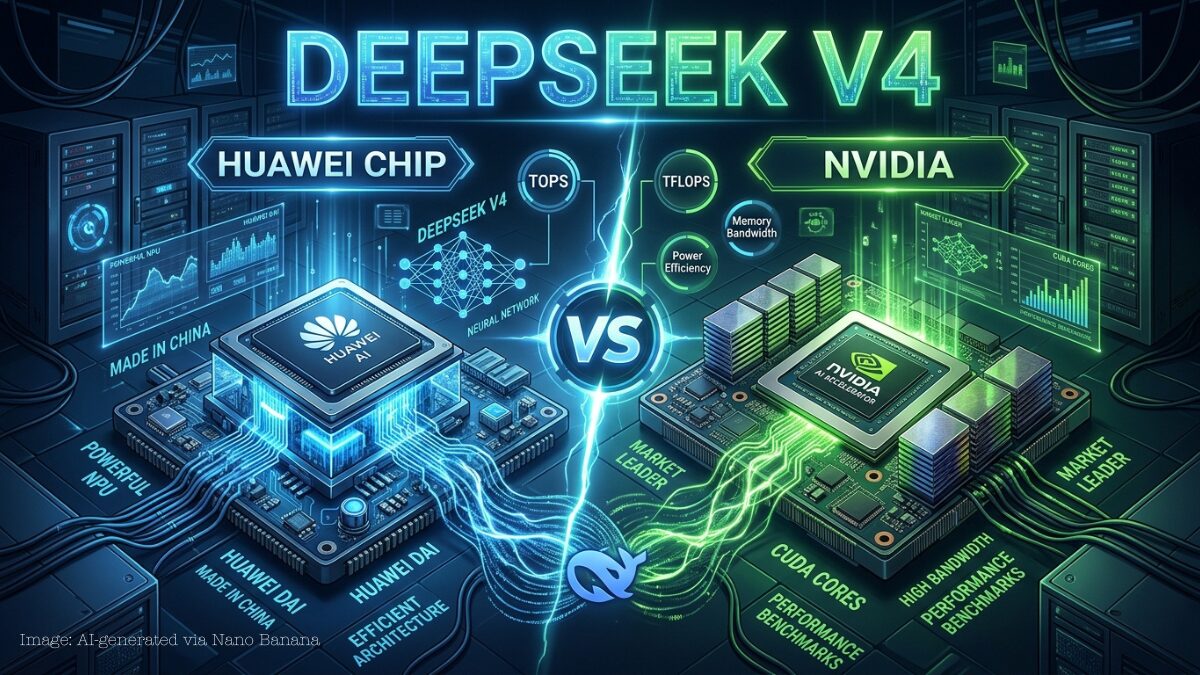
Chinese AI startup DeepSeek introduced its V4 model in April 2026 with support for Huawei Ascend chips. The update enables the model to run on domestic hardware, reducing reliance on foreign technology and strengthening AI development across Asia-Pacific markets.
AI development is increasingly shaped by global supply chains, particularly access to advanced semiconductors. U.S. export restrictions on high-end chips have pushed Chinese companies to accelerate the development of domestic alternatives.
This shift has led to closer collaboration between AI developers and local hardware manufacturers, aiming to build self-sufficient ecosystems that can support large-scale AI training and deployment without relying on foreign suppliers.
What is DeepSeek V4 and what makes it significant?
DeepSeek V4 is a next-generation AI model designed to deliver strong performance while operating on domestic hardware infrastructure.
The model introduces improvements in reasoning, coding, and long-context processing, including support for significantly larger inputs. It is positioned as a competitive alternative to leading global AI systems, particularly in enterprise and developer use cases.
As reported by Reuters (2026), DeepSeek V4 includes a 1-million-token context window and comes in multiple versions optimized for performance and cost efficiency.
How does Huawei chip support change AI deployment?
Huawei chip support allows DeepSeek V4 to run on locally developed Ascend processors instead of relying on foreign hardware.
This marks a major shift from earlier models that depended on Nvidia chips, enabling companies to deploy AI systems within domestic infrastructure. It also helps address supply limitations caused by export controls.
Data from Reuters (2026) shows Huawei’s Ascend 950-based systems now fully support DeepSeek V4, including its deployment on large-scale AI clusters.
What does this mean for global AI competition?
DeepSeek V4 increases competition in the global AI market by introducing a viable alternative built on non-Western technology.
Its ability to run on Huawei hardware challenges the dominance of Nvidia-powered systems and signals a shift toward diversified AI ecosystems. While it may still trail top closed-source models, its cost efficiency and accessibility make it a strong competitor.
What happens next?
DeepSeek is expected to expand V4 availability throughout 2026, with broader deployment across enterprise and cloud platforms in Asia-Pacific markets. Huawei is also likely to scale its Ascend chip infrastructure to support growing demand, while global competition intensifies as companies race to build independent AI ecosystems.
To see how global AI competition is shifting toward automation and enterprise tools, read “Google Unveils Enterprise AI Agent Tools at Cloud Next 2026”. It explains how major tech firms are building AI systems that can execute real-world tasks.