
Last Updated on May 24, 2026 by Spencer Lee
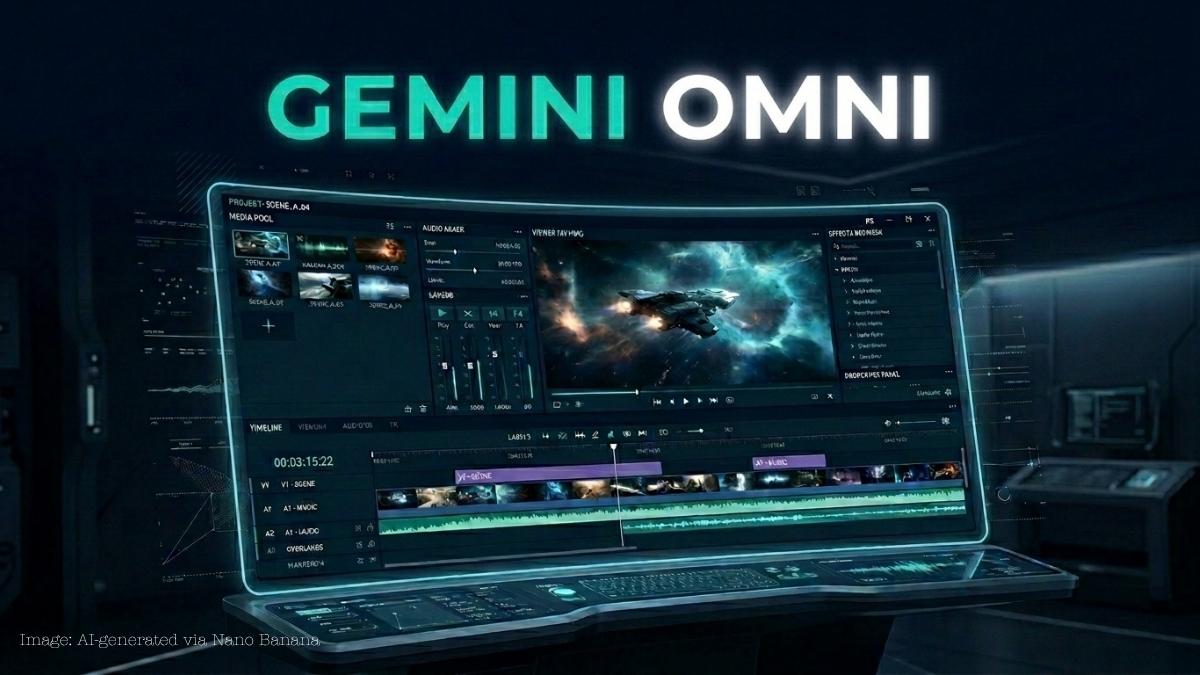
Google introduced Gemini Omni, a new multimodal AI model family capable of generating and editing video using text, images, audio, and video inputs. The company says the system is designed to eventually “create anything from any input,” starting with AI-powered video generation.
AI companies are rapidly expanding beyond text generation into multimodal systems capable of understanding and producing video, audio, images, and interactive content. Competition has intensified as firms race to develop AI tools that can create cinematic-quality media while maintaining consistency across multiple edits and prompts.
Google has increasingly focused on “world models,” AI systems designed to simulate real-world physics, movement, and contextual understanding rather than generating isolated media outputs.
What is Gemini Omni?
Gemini Omni is Google’s new multimodal AI model family designed to generate and edit media from multiple input types simultaneously.
The system can combine text, images, audio, and video into a unified workflow capable of producing AI-generated video outputs. Google says the first release, Gemini Omni Flash, focuses on video generation and conversational editing.
Google DeepMind CTO Koray Kavukcuoglu described Gemini Omni as a model that can “create anything from any input — starting with video.”
How is Gemini Omni different from previous AI video tools?
Unlike traditional text-to-video systems, Gemini Omni is designed to reason across multiple forms of media simultaneously.
Users can upload existing videos, images, audio clips, and prompts while continuing to refine scenes through conversational edits. Google says the model maintains character consistency, lighting, object behavior, and scene continuity across multiple revisions.
The company also claims Gemini Omni has improved understanding of physics concepts such as gravity, fluid dynamics, and kinetic motion, helping generate more realistic scenes.
Where will Gemini Omni be available?
Google is rolling out Gemini Omni Flash across several consumer and creator platforms.
The model is being integrated into the Gemini app, Google Flow, YouTube Shorts, and YouTube Create. Broader API access for developers is expected later in 2026.
Google also confirmed that videos generated with Gemini Omni will include SynthID watermarking technology designed to identify AI-generated media.
Why is multimodal AI becoming important?
AI companies increasingly view multimodal systems as the next major step beyond chatbots and text generation.
Rather than treating images, audio, and video separately, multimodal models attempt to understand how different media types interact together within real-world environments. This could improve creative workflows, video production, simulation systems, gaming, and AI assistants.
Online reactions from creators and developers have focused heavily on Gemini Omni’s “stateful” editing system, which allows iterative changes without resetting scenes or losing continuity.
What challenges could Gemini Omni face?
Despite strong interest, AI-generated video systems still face concerns around misinformation, copyright, deepfakes, and computational costs.
Google has limited some advanced voice and identity manipulation features while it evaluates safety risks and policy controls. Analysts also note that maintaining long-form coherence and realistic physics remains difficult for current AI video systems.
Competition is also intensifying as OpenAI, Runway, Adobe, and Chinese AI firms continue developing their own multimodal video-generation platforms.
What happens next?
Google is expected to continue expanding Gemini Omni throughout 2026 with broader developer access, additional media-generation capabilities, and deeper integration across YouTube and creative tools. Analysts expect multimodal AI systems to become a major battleground in the next phase of generative AI competition.
To see how AI-generated video platforms are becoming major standalone businesses, read “Kuaishou Considers Kling AI Spin-Off at $20 Billion Valuation”. The article explores the growing competition in multimodal AI video generation and creator-focused media tools.