
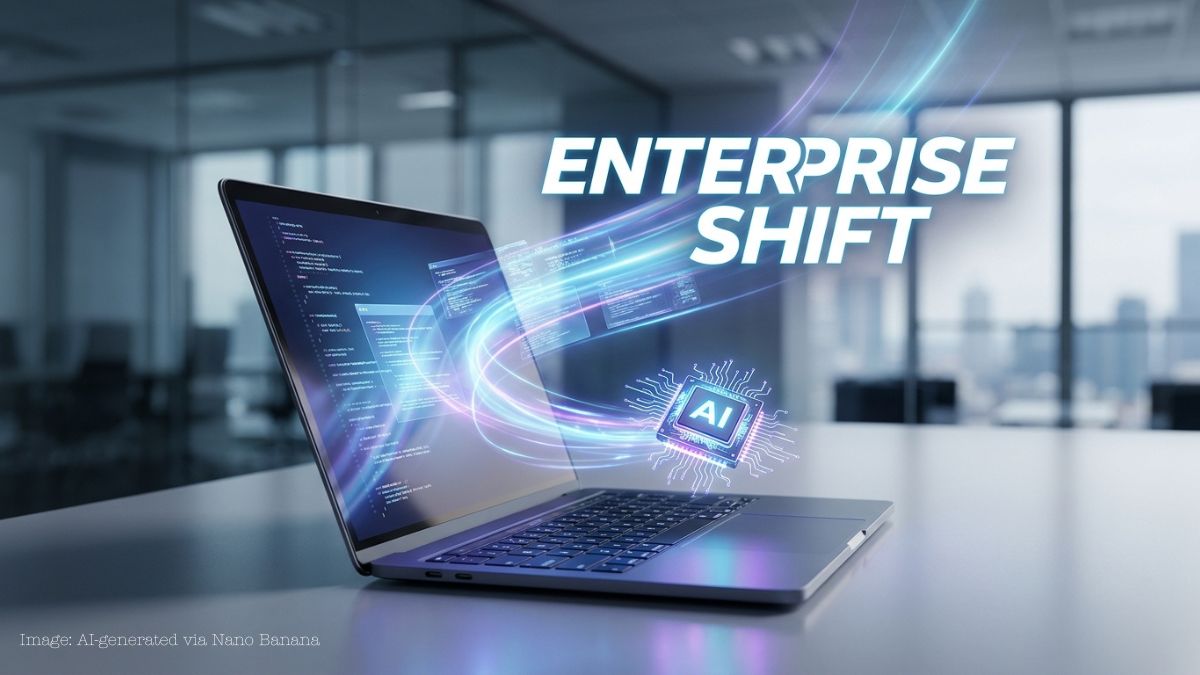
AMD is accelerating its push into AI-powered PCs as enterprise adoption grows in 2026. A new industry analysis shows increasing deployment across businesses, while challenges such as integration, cost, and readiness continue to slow large-scale rollout.
AI PCs—devices capable of running AI workloads locally—are becoming a major focus for the semiconductor industry. These systems enable faster processing, improved privacy, and reduced reliance on cloud infrastructure.
As businesses integrate AI into daily operations, demand for on-device computing is rising. However, enterprise adoption depends on more than hardware performance, requiring software compatibility, workforce readiness, and infrastructure alignment.
What is driving AI PC adoption in enterprises?
AI PC adoption is being driven by the need for faster, on-device AI processing and improved data privacy.
Enterprises are increasingly deploying AI-enabled systems to handle real-time analytics, automation, and decision-making without relying entirely on cloud services. This shift allows businesses to reduce latency and improve operational efficiency.
How is AMD positioning itself in the AI PC market?
AMD is positioning itself as a key player by integrating AI capabilities directly into its processors.
The company is focusing on enabling AI workloads on-device, supporting enterprise applications such as productivity tools, automation systems, and data analysis. This aligns with a broader industry shift toward edge computing.
What does the data say about AI PC deployment?
Enterprise adoption of AI PCs is growing, but large-scale deployment remains gradual due to operational challenges.
Findings cited by IDC (2026) indicate that organizations are moving from early experimentation toward broader deployment, particularly in regions like Asia-Pacific. However, adoption varies depending on readiness and infrastructure.
What challenges are slowing adoption?
Despite growing interest, enterprises face barriers such as cost, compatibility issues, and integration complexity.
Many businesses rely on legacy systems that are not optimized for AI workloads, making deployment more difficult. Additionally, workforce skill gaps and software limitations can delay adoption timelines.
Supporting data from Qualcomm (2026) highlights that successful AI deployment requires ecosystem development, including tools, training, and partnerships to scale effectively.
What does this mean for the future of AI PCs?
The growth of AI PCs signals a long-term shift toward distributed computing, where AI processing happens closer to the user.
As hardware improves and software ecosystems mature, adoption is expected to accelerate. Companies that address integration challenges and build strong developer ecosystems will likely lead the market.
What happens next?
AMD is expected to continue expanding its AI PC ecosystem throughout 2026, focusing on partnerships, software optimization, and enterprise solutions. As adoption increases, improvements in compatibility and workforce training will play a critical role in scaling deployments across industries.
To see how edge AI is shaping hardware strategies, read “Qualcomm Edge AI Push Tests Valuation Amid Startup Growth”. It explains how companies are expanding AI beyond traditional cloud systems.