

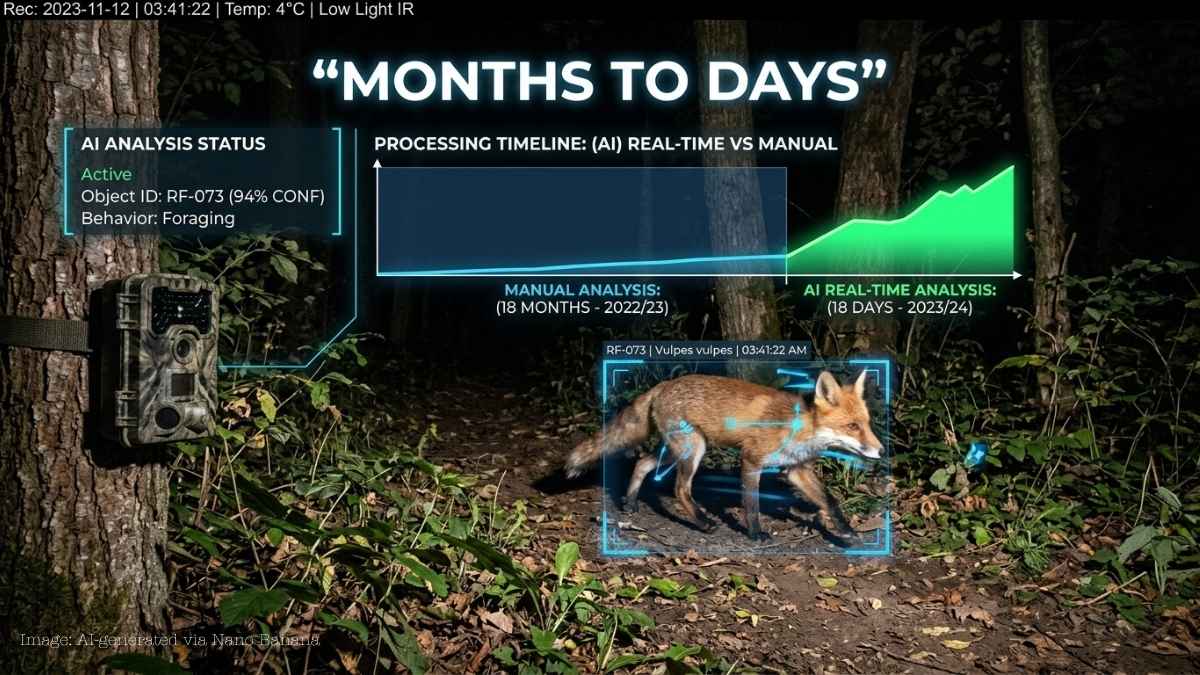
Researchers from Washington State University and Google developed an AI system that reduces wildlife tracking analysis from months to just days. The technology processes camera trap images automatically, helping conservationists monitor species faster and make quicker environmental decisions.
Wildlife conservation groups use motion-activated camera traps to monitor animal populations in forests, parks, and remote ecosystems. These projects generate hundreds of thousands to millions of images, creating major delays because researchers must manually identify species and behaviors.
Traditional review processes can take six months to a year before scientists can begin ecological analysis. This bottleneck slows conservation efforts, especially for smaller organizations with limited funding and personnel.
How does the AI system speed up wildlife tracking?
The AI system automates the identification and analysis of animals captured in camera trap images, reducing processing time dramatically.
Instead of relying on teams of human reviewers, researchers used Google’s SpeciesNet AI model to classify wildlife images automatically. The system analyzed data from Washington state, Montana’s Glacier National Park, and Guatemala’s Maya Biosphere Reserve.
A study published in the Journal of Applied Ecology (2026) found the AI system reduced wildlife tracking analysis from six to twelve months down to a few days, while maintaining similar scientific conclusions to human experts.
How accurate was the AI compared to humans?
The AI-generated ecological models closely matched results produced by human researchers in most cases.
Researchers found that AI-derived occupancy models aligned with human-generated models in roughly 85% to 90% of cases, even when the AI occasionally misidentified species or missed detections.
“The key question wasn’t whether the AI got every image right,” said Dan Morris, senior staff research scientist at Google. “It was whether the ecological conclusions you care about would end up being basically the same.”
Why is this important for conservation groups?
Faster image analysis allows conservation teams to respond more quickly to environmental changes and threats.
Smaller organizations often lack the staff and resources needed to process large datasets manually. Automated AI systems can help them scale monitoring efforts without significantly increasing costs or manpower.
“We’re not trying to replace people,” said Daniel Thornton, lead author of the study and wildlife ecologist at Washington State University. “The goal is to help researchers get to answers faster so they can make better decisions about managing and conserving wildlife.”
What are the limitations of the AI system?
The AI system still struggles with rare species and animals that are difficult to distinguish visually.
Researchers noted that human oversight remains necessary for some applications, particularly when analyzing uncommon species or conducting more detailed behavioral studies.
The study also emphasized that occupancy models remain reliable because they depend on repeated observations over time, reducing the impact of occasional AI errors.
What happens next?
Researchers plan to continue improving SpeciesNet and expanding datasets to improve AI accuracy across more species and ecosystems. Conservation groups may increasingly adopt fully automated wildlife monitoring systems over the next few years, enabling near real-time tracking of endangered animals and environmental changes.
To see how AI is being used in other real-world monitoring systems, read “AI Detects Pancreatic Cancer Up to 3 Years Earlier”. The article explains how machine learning is helping researchers analyze complex medical imaging data faster and more accurately.