
Hybrid work wins for most professionals who need both collaboration and focus time — but fully remote work is the better fit if your role is output-driven and you have a disciplined home setup. Neither model is universally superior. Your productivity style, career goals, industry, and living situation all determine which arrangement lets you do your best work. Choosing wrong doesn’t just hurt your output — it affects your wellbeing, visibility, and long-term career trajectory.
Why the Remote vs. Hybrid Debate Isn’t Going Away
The shift to flexible work didn’t end when pandemic restrictions lifted. It accelerated. Millions of workers who discovered they could perform — and in many cases, outperform — their office-bound counterparts have no intention of reverting. Companies, meanwhile, are pulling in the opposite direction, issuing return-to-office mandates at the same time they’re competing for talent that now expects location flexibility as a baseline.
This tension has turned the remote-versus-hybrid question into one of the most consequential career decisions a knowledge worker makes today. It affects where you can live, how you manage your time, how fast you advance, and whether your employer even trusts you. By the end of this article, you’ll understand the structural differences between both models, know exactly what each one costs and delivers, and have a framework for making the decision that fits your life — not someone else’s trend report.
What Is the Real Difference Between Remote and Hybrid Work?
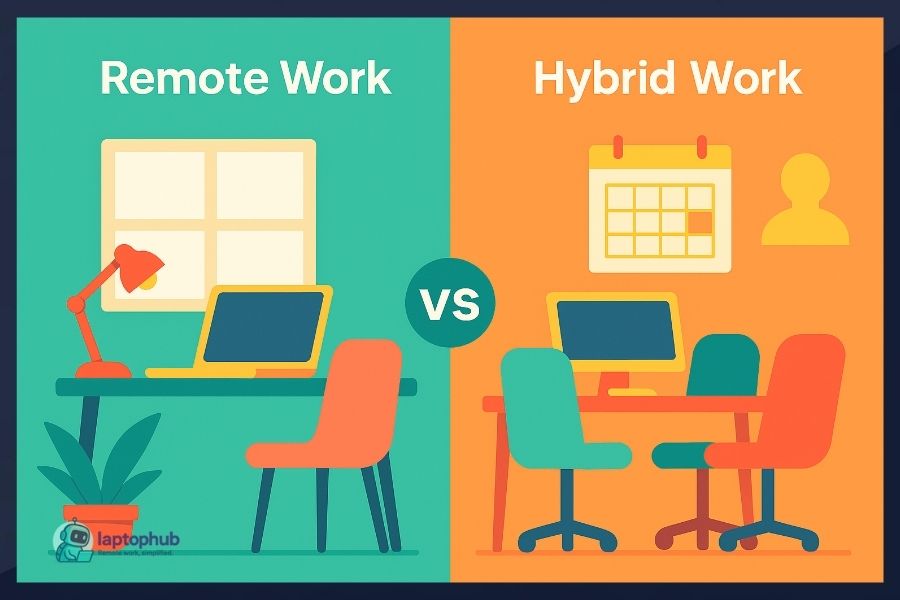
Remote work means your job is performed entirely outside a central office. You may work from home, a coworking space, a café, or across time zones — as long as you meet your deliverables. Hybrid work, by contrast, splits time between remote and in-office, with employees typically spending two to three days on-site per week. Some hybrid models are structured (fixed office days assigned by the company); others are flexible (employees choose when to come in).
The distinction sounds simple, but the operational implications are significant. Remote work demands full digital infrastructure, asynchronous communication habits, and stronger self-management skills. Hybrid work demands the ability to context-switch — moving between deep solo work at home and high-bandwidth in-person collaboration — without losing momentum in either setting.
Knowing which mode energizes you, rather than drains you, is the most important variable in this decision.
How Does Each Model Affect Productivity?
Remote work raises productivity for roles that require sustained concentration. Writing, coding, financial analysis, design, and research all benefit from uninterrupted blocks of time — something most open-plan offices make difficult to achieve. Without commute friction and with full control over environmental variables, remote workers frequently report completing more high-quality work in fewer hours.
Hybrid work edges ahead for roles that depend on rapid iteration and team alignment. When debugging a product roadmap, onboarding a new client, or resolving cross-functional conflict, a 20-minute in-person conversation often accomplishes what days of async messaging cannot. A Gallup study found that hybrid workers reported slightly higher engagement scores than their fully remote counterparts, though both groups outperformed fully in-office employees on satisfaction and retention metrics.
The critical mistake workers and employers alike make is assuming productivity is uniform across all tasks. High-output professionals typically blend both: deep work is done remotely, collaborative work in person. If your hybrid schedule forces you to commute for tasks you could have done from home, you’re getting the cost of the office without the benefit.
Which Work Model Is Better for Work-Life Balance?
Remote work gives you the most control over your time. You can structure your day around your energy rhythms, eliminate commute hours entirely, and build routines that support your physical and mental health. Parents can be more present. People managing chronic conditions or caregiving responsibilities gain flexibility that no hybrid policy can fully replicate.
The risk is boundary collapse. When your workspace and living space overlap, the psychological cue to stop working disappears. Remote workers are statistically more likely to work late and check messages outside hours — not because employers demand it, but because the physical separation that once enforced an “end of day” no longer exists. Without deliberate structure, remote work can become the most demanding model of all.
Hybrid work reintroduces physical transitions that help people mentally switch off. An office day has a clear start and end. The commute home, however brief, functions as a decompression buffer. For workers who struggle with self-imposed boundaries, this structure isn’t a concession — it’s a feature.
What Happens to Career Growth When You Work Remotely?
Proximity bias is real, documented, and still operating inside most organizations that haven’t made deliberate structural changes to counteract it. Employees who are physically visible tend to receive more informal mentorship, get pulled into conversations about upcoming projects, and are more likely to come to mind when leadership considers promotions. This is not a policy — it’s a pattern.
Hybrid workers are positioned to benefit from in-person visibility while retaining flexibility the rest of the week. Remote workers can close the gap, but it requires deliberate effort. According to research from Stanford economist Nicholas Bloom, remote workers received 50% fewer promotions than in-office peers at companies that had not implemented explicit remote-equity policies.
To grow your career remotely, you need to operate with more intentionality than your in-office peers:
- Document outputs, not hours. Make your contributions legible to people who can’t observe your work.
- Overcommunicate upward. Share progress proactively so leadership has a mental model of your contribution.
- Build digital presence. Slack activity, written proposals, and virtual presentations become your visibility layer.
- Seek mentors who operate remotely. They’ll give you honest guidance on advancement paths that don’t require physical presence.
- Request visibility opportunities. Volunteer for cross-functional projects that put you in contact with senior stakeholders.
What Tools and Setup Do You Actually Need?
Your work model determines your infrastructure requirements — and underinvesting in either setup is one of the most common mistakes people make.
For fully remote workers, the home office is your primary workplace and must be treated as such. High-speed internet with a backup option, a dedicated ergonomic workstation, noise-canceling headphones, and professional-grade video and audio for calls are non-negotiable. The tools that matter most are project management platforms (Notion, Asana, Linear), communication infrastructure (Slack, Zoom), and documentation systems that make your work findable by people who aren’t in the same room.
For hybrid workers, the challenge is portability and consistency. You need a setup that travels — a laptop optimized for both home and office environments, cloud-synced files accessible from any device, and a calendar that clearly signals your location to colleagues each day. The coordination overhead of hybrid is higher than most people anticipate: not knowing which colleagues are in on which days eliminates the spontaneous collaboration that makes hybrid work valuable in the first place.
🖥️Also read: Best Remote Work Tools 2025: What Smart Teams Are Using Now
How Do You Know Which Model Is Right for You?
Before defaulting to whatever your employer offers, answer these six questions honestly:
- Do I produce better work alone or in proximity to colleagues? Some people need ambient human energy to stay engaged. Others are derailed by it.
- Can I enforce my own boundaries? If your evenings already blur into work, fully remote will likely worsen that pattern without intervention.
- Does my role require real-time collaboration? Daily stakeholder management, creative brainstorming, and hands-on training are harder to replicate asynchronously.
- What does my home environment support? A dedicated room with a door functions differently than a shared apartment with roommates.
- How important is in-person visibility for advancement in my company? Be honest about your organization’s culture, not its stated values.
- What does my mental health need? For people prone to isolation or depression, the social dimension of hybrid may be worth a commute. For those with anxiety, the sensory demands of an open office may erode more than they gain.
There is no objectively correct answer. What matters is that your model matches your actual work style — not the identity you want to project.
Remote vs Hybrid Work FAQs
For deep, focused tasks; coding, writing, and analysis, remote work typically produces better output. For collaborative, fast-moving, or relationship-driven work, hybrid has the edge. The answer depends entirely on what your role actually requires most.
Technology, software development, digital marketing, content creation, finance (particularly fintech), and consulting all have high concentrations of remote-eligible roles. Healthcare, manufacturing, and legal services remain largely in-person, with remote options limited to administrative functions.
Yes, and performance data is your strongest negotiating tool. Proposing a trial period with measurable outcomes reduces your employer’s perceived risk. The more you can demonstrate that your output is location-independent, the stronger your position.
At companies without explicit remote-equity policies, yes. Research suggests remote employees receive promotions at lower rates than in-office peers. The risk is manageable with proactive visibility strategies, but it’s a real structural disadvantage in traditional organizations.
Proximity bias is the tendency of managers to favor employees they physically see more often. Hybrid work reduces the gap compared to fully remote, but doesn’t eliminate it — especially if your office days don’t overlap with your manager’s.
It depends on the individual. Hybrid work provides social interaction and physical transitions that help some people maintain structure and avoid isolation. Others find the commute and context-switching more draining than energizing. Neither model is universally healthier.
Focus on quality, not quantity of communication. Send concise progress updates at regular intervals, contribute visibly to async threads, and make sure your wins are documented in places leadership reviews — not just mentioned in passing on Slack.
Final Verdict: Which One’s Best for You?
The remote-versus-hybrid decision is ultimately a question of fit, not preference. Remote work delivers maximum autonomy and demands maximum self-discipline. Hybrid work offers social continuity and structural rhythm, with a commute and coordination cost attached. Neither model inherits the other’s strengths automatically — both require deliberate setup, clear communication norms, and employer cultures that evaluate output rather than presence.
Start by auditing one week of your actual work: how much of it genuinely requires other people in real time, and how much depends on uninterrupted focus? Let that data, not workplace trends, guide your decision. If you’re negotiating with an employer, come prepared with specifics — not just a preference, but a case for why your particular role and output would be better served by the arrangement you’re requesting.