

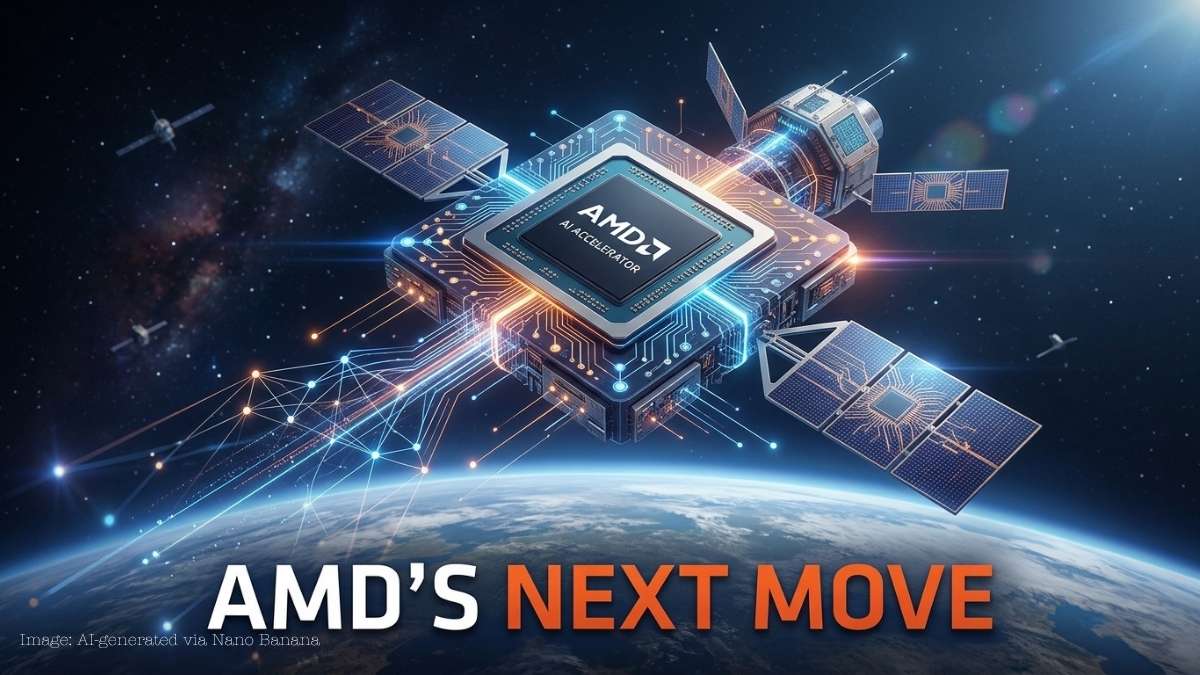
AMD is expanding its AI ambitions into space computing, targeting satellites and orbital systems that require real-time data processing. The company says edge AI in space could improve communications, navigation, and autonomous operations for future missions.
Space systems are generating increasing amounts of data from satellites, sensors, and onboard instruments. Processing that information on Earth can introduce delays, especially for missions requiring real-time decisions and autonomous responses.
To address this, technology companies are exploring edge AI systems capable of processing data directly in orbit. These systems reduce latency and improve efficiency by enabling spacecraft and satellites to analyze information without relying entirely on ground stations.
Why is AMD focusing on AI for space computing?
AMD sees space computing as a growing market for edge AI systems that require fast, low-power data processing.
The company believes AI chips designed for real-time workloads can help satellites and spacecraft process information locally instead of sending all data back to Earth. This approach improves speed, reduces bandwidth requirements, and supports autonomous operations.
Executives cited by the Daily Tribune (2026) said AI-driven space computing could play a major role in future communications, navigation, and scientific missions.
How can AI improve satellite and orbital systems?
AI systems can analyze sensor data in orbit, allowing satellites to make faster operational decisions.
This includes detecting anomalies, optimizing communication routes, managing power systems, and processing imaging data without waiting for instructions from Earth. Real-time onboard analysis is especially important for deep-space missions and defense applications.
Industry experts note that edge AI reduces latency and improves resilience in environments where communication delays can disrupt mission performance.
What technologies is AMD bringing to space computing?
AMD is leveraging its AI accelerators, adaptive computing platforms, and energy-efficient processors for space-focused workloads.
The company has increasingly positioned itself as a competitor in high-performance AI hardware, particularly in edge computing and embedded systems. These technologies are well suited for environments where power efficiency and reliability are critical.
The broader AI hardware market has intensified as chipmakers compete to expand beyond data centers into automotive, industrial, and aerospace applications.
Why is edge AI becoming important in space missions?
Edge AI enables systems to process information locally instead of relying entirely on remote infrastructure.
In space, communication delays and bandwidth limitations make real-time processing essential. AI can help spacecraft react immediately to environmental changes or system failures without waiting for commands from Earth.
This shift is expected to support more autonomous satellites, smarter space infrastructure, and future deep-space exploration missions.
What happens next?
AMD is expected to continue developing AI hardware optimized for aerospace and edge computing throughout 2026. As governments and private space companies increase investment in orbital infrastructure, demand for onboard AI processing systems is likely to grow significantly over the next several years.
To see how AI hardware is expanding into real-world infrastructure, read “Blaize, Winmate Partner to Deploy AI in Rugged Systems”. The article explains how edge AI is being integrated into defense and critical infrastructure environments.