

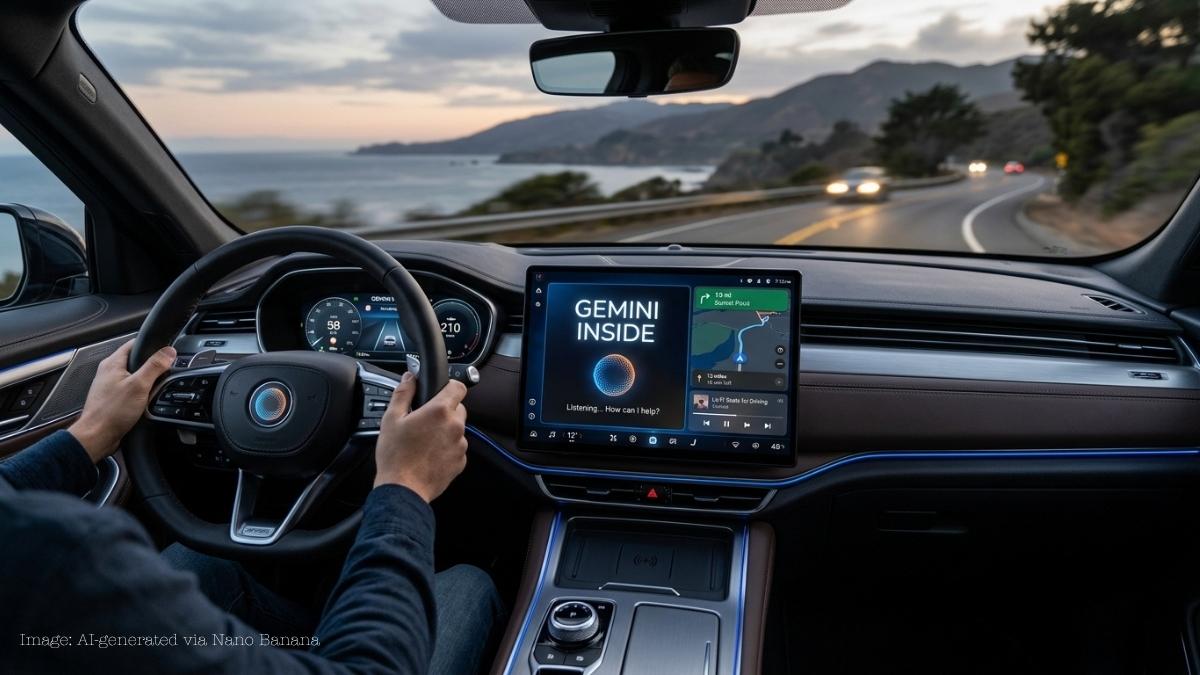
General Motors is rolling out Google Gemini to about 4 million vehicles in the U.S. in 2026. The update replaces Google Assistant with a more advanced conversational AI, enabling drivers to interact with their cars using natural language.
Automakers are rapidly integrating artificial intelligence into vehicles to improve user experience and enable smarter, connected systems. These efforts focus on voice assistants, navigation, and real-time decision-making inside cars.
At the same time, technology companies are expanding their AI platforms beyond smartphones and computers into physical environments like vehicles. This shift reflects growing demand for AI-powered interfaces that can operate seamlessly in everyday settings.
What is GM’s Google Gemini vehicle update?
GM is deploying Google Gemini as a new in-vehicle AI assistant across millions of its cars through over-the-air updates.
The rollout applies to model year 2022 and newer vehicles from Cadillac, Chevrolet, Buick, and GMC that already include Google built-in systems. The update replaces the existing Google Assistant with a more advanced AI.
As stated by General Motors (2026), approximately 4 million vehicles in the U.S. are eligible, making it one of the largest AI deployments in the automotive industry.
What can Gemini do inside GM vehicles?
Gemini enables more natural, conversational interactions between drivers and their vehicles.
Drivers can send messages, navigate, control media, and plan trips using everyday language instead of memorizing commands. The system also allows follow-up questions and context-aware responses, improving usability.
Supporting reports (2026) note that Gemini can handle tasks such as message summaries, route planning, and personalized recommendations, while adapting to user context in real time.
Why is GM replacing Google Assistant with Gemini?
GM is upgrading to Gemini to provide a more advanced and intuitive AI experience.
Unlike traditional voice assistants, Gemini is designed for continuous conversation and contextual understanding. This allows users to interact more naturally, similar to speaking with a human.
The move aligns with Google’s broader strategy to phase out older Assistant systems in favor of more capable AI models across devices.
What does this mean for the future of AI in cars?
The rollout signals a major shift toward AI-powered, software-defined vehicles.
By embedding advanced AI assistants directly into cars, automakers can offer more personalized and dynamic user experiences. This also opens the door for future features such as predictive recommendations and deeper integration with vehicle systems.
What happens next?
General Motors will continue rolling out Gemini updates over several months in 2026, with plans to expand to more regions and languages. The company is also expected to introduce a more advanced, custom-built AI assistant later in the year, further integrating AI into vehicle systems.
To see how AI is expanding beyond devices into real-world systems, read “Google Secures Classified AI Deal With Pentagon”. It explains how AI is being deployed across critical infrastructure and defense.