
Last Updated on October 29, 2026 by Spencer Lee
NVIDIA announced new software and AI model updates for its RTX Spark laptops on October 28, 2026. The update introduces GPU resource controls that let users prioritize foreground applications or background AI agents. It also adds support for Liquid AI’s LFM3 models and introduces a new open-weight speech model for local AI workflows.
NVIDIA is expanding the software capabilities of its RTX Spark laptop platform, shifting attention from hardware specifications to the practical experience of running AI alongside everyday applications.
For laptop users, the key development is the ability to adjust how GPU resources are shared between active applications and background AI agents. New model support also expands the types of local AI workflows developers can explore.
In its October 28 RTX Spark update, NVIDIA outlined the new resource management feature, support for additional AI models, and updates for gaming and creative applications.
What new GPU controls are coming to RTX Spark laptops?
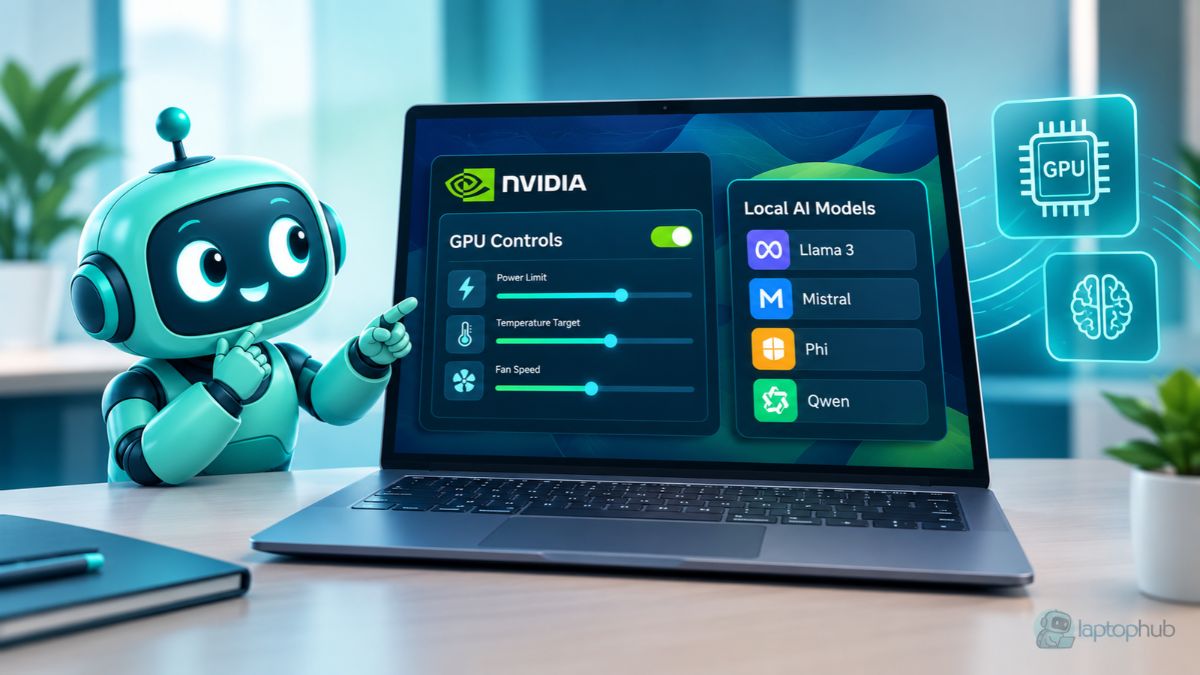
NVIDIA is introducing resource management controls through the NVIDIA App, allowing users to adjust how GPU computing resources are shared between foreground applications and background AI agents.
This addresses a practical problem with local AI: an agent processing documents or completing tasks in the background may compete with the application a user is actively working in.
The new controls let users prioritize their foreground application when responsiveness matters, or allocate more resources to a background agent when completing its task is more important.
NVIDIA says the feature is accessible under System > Advanced in the NVIDIA App. Hardware-accelerated GPU scheduling must also be enabled in Windows Settings.
The feature does not create additional GPU computing capacity. Instead, it gives users more control over how existing resources are allocated.
Which new AI models can run on RTX Spark?
NVIDIA highlighted two important model developments in its October 28 announcement.
NVIDIA Nemotron 3.5 Transcribe
Nemotron 3.5 Transcribe is an open-weight speech model designed to transcribe recorded audio, identify speakers, translate speech, and answer questions about recordings.
NVIDIA says the model supports 40 languages, including seven Indic languages. Developers can use natural-language instructions to customize transcription tasks, making it potentially useful for meeting notes, interviews, and other recorded conversations.
The model was released on October 28, but NVIDIA says quantized versions needed for local deployment on RTX Spark are coming soon. Developers should therefore distinguish between the model’s general availability and its readiness for a particular laptop configuration.
TechCrunch’s report on Nemotron 3.5 Transcribe also notes that the model is intended for recorded audio rather than live transcription.
Liquid AI’s LFM3 model family
NVIDIA also announced support for Liquid AI’s LFM3 family of open-weight models.
The family includes models for text, vision, audio, multimodal tasks, and decision-making. NVIDIA says developers can run LFM3 models on RTX Spark using llama.cpp and vLLM, with local fine-tuning also supported.
These capabilities could support workflows such as reading documents, processing speech, managing inboxes, and powering AI agents. Actual performance will depend on the model selected, the software configuration, and the laptop’s available resources.
What do these updates mean for laptop users?
The changes make RTX Spark more interesting for people who want to run AI agents while continuing to use their laptops for other work.
Consider a developer running a local AI agent that processes files in the background while editing code. Resource management could help prioritize the coding application when responsiveness matters, or favor the agent when a background task needs to finish sooner.
Additional model support also expands the potential uses of local AI, particularly for transcription, document processing, and agent-based workflows.
However, these updates do not guarantee that every model will run smoothly on every RTX Spark configuration. Users still need to consider model size, memory requirements, software compatibility, and the demands of other applications.
For buyers comparing high-memory AI laptops, the hardware remains important, but software support and resource management are also becoming meaningful parts of the experience.
Does this change the RTX Spark hardware requirements?
No. The announcement focuses on software controls, model availability, and application support rather than a new hardware configuration.
RTX Spark laptops continue to use NVIDIA’s combined CPU and GPU architecture with unified memory. NVIDIA lists configurations with up to 128GB of unified memory and up to 1 petaflop of FP4 AI performance.
Those specifications describe the platform’s maximum capabilities, not a guarantee that every supported AI workload will achieve a particular speed.
What happens next?
The next important milestone for local AI users is the arrival of the quantized Nemotron 3.5 Transcribe versions intended for RTX Spark deployment.
Users should also watch for broader software compatibility and independent testing that measures how the new resource controls affect application responsiveness and background AI workloads.
For now, NVIDIA’s announcement is primarily a software update: it gives RTX Spark users more control over competing workloads and adds more options for developing local AI applications.
Also read: NVIDIA RTX Spark Brings 128GB Memory to AI Laptops